



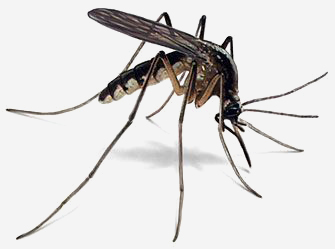
Mosquitoes are Diptera insects of the Culicidae family with approximately 3,500 species worldwide.
The slim and long body of the adult mosquito is covered by scales and has long, very thin legs that allow it just to stand. Its wings are membranous. It is characterized by an elongated proboscis protruding from its oral cavity.
The male mosquito has more hairy antennas than the female. Mosquitos are feed on nectar or pollen found in nature, but females also need blood to lay eggs.
As soon as female mosquitoes make a blood meal, their ripen eggs are placed on water surface and then the larvae which feed on various organic residues are hatched. Some mosquito larvae feed on other mosquitoes or other small insects. The larvae are aquatic species and equipped with two respiratory systems which enable them to breath both under and above water.
The elastic piece at the bottom of their bellies allow them to move faster by hitting water. When mosquito reaches adulthood, it comes out from larvae back and then uses its body to float in the water before it can fly.
Mosquitoes are irritated and attracted by movement, body heat, humidity and carbon dioxide releasing by breathing. Their whistle comes from their synchronized flicker. They can be transported to long distances, due to their low resistance on wind.
Their activity is affected by temperature and air humidity. Thus, in early morning hours, early night hours and during the night, most species are very activated. There are also species that sting around the clock.
Female mosquitoes pierce the skin with the 6 «pins» existing in their mouth, extract a haemolytic and antihistamine saliva and with their proboscis, absorb the blood which is released into the stomach. Depending on the blood quantity, stomach can accordingly fluctuate in size thanks to its elasticity. Mosquitoes’ bite cause redness on skin, swelling and very irritating itch. It is noted that a darker skin attracts more mosquitos than a lighter one.
There are three common mosquito genera:
- Anopheles mosquito. Anopheles mosquitoes serve as vectors of malaria, encephalitis and filariasis diseases. Adult mosquitoes of this genus are recognized by their body posture, where the proboscis, head and body are in a straight line. Their winds have also small spots. By biting a person with malaria, the female mosquito except from blood suckle the plasmodium which is responsible for the disease. Inside mosquito’s body, the germ remains and grows. It is then transferred to its salivary glands and thus, with a new bite to a healthy human body, carries the germ through its saliva into its body. Anopheles mosquito lives from 18 days to 4-5 weeks.
- Culex mosquito. This type multiplies in stagnant and polluted waters as well as in humid environments. Its proboscis is discontinuous and downward related to the rest of its body. The winds are disparately colored. Mosquitos lay their eggs on water surface, which they float in groups of 100 or more. Their life expectancy is 10-15, and in some cases they can live longer. They can serve as vectors of encephalitis (quite difficult) and filariasis (only in tropical environments).
- Aedes mosquito. Aedes mosquitoes serve as vectors of yellow fever. They differ from the culex mosquitoes in the silver color of its chest. The tip of female mosquitoes’ stomach have sharp edge and several prominent sensory components. The larvae of this type are short and thick while their egg can survive outside water for long time. Reproduce after flooding in rainwater tanks or salt marshes. Their life expectancy is 10-15. Under conductive cold climate conditions, aedes mosquitoes can live up to several months.